Thursday, September 30, 2010

The 1920s: Puppet emperors, racist talkies and very strong winds


Watching movies from the 1920s has made me realize just how short my attention span really is. In fact it's so short I

As part of my Decades series, in which I examine movies from a particular decade between the 1920s and the 1970s during a particular month, I watched three films from the 1920s during September -- the late 1920s, at that. But I couldn't get through any of them without taking a peek at my laptop -- and two of them were actually really good. (The third one is probably the one that film historians would praise, but I couldn't get into it.)

Looking at your laptop is about the worst thing you can do in a silent film. Since all of the plot information is being communicated visually, you can't just look away and keep listening. It's like trying to watch a foreign movie while you're eating dinner. It just doesn't work. You lose too much information while looking down to make sure your food is securely positioned atop your fork.

But that's a good indication of how much my attention drifted during these movies, and how slow I found their pace to be. I thought I could check an email, play a turn in Lexulous, and still have a pretty good idea what was going on, as long as I kept some of my attention on noticing when the dialogue cards came on the screen, so I'd be sure not to miss any written words. Well, this came back to bite me on the butt on at least one occasion. And without any further ado, let's get to that ...

Storm Over Asia (1928, Vsevolod Pudovkin). Watched: Wednesday, September 8th

Storm Over Asia was on my radar as a film recommended in the massive tome 1,001 Films To See Before You Die. My wife owns a version that I believe is a good ten years old, so it doesn't include the classics from this past decade. But it's a pretty good compendium of what came before. I actually started a project to go through this chronological book and record all the titles in a spreadsheet, to see which ones I had and hadn't seen, and to check them off when I'd seen them. I only got through about 1931, due in part to the fact that this is only about seventh or eighth among my movie projects, let alone other projects. But that meant that Storm Over Asia had entered my awareness, enough for me to throw it on my (now-defunct) Blockbuster queue.

And so when I knew I'd be watching movies from the 1920s, and scanned my queue for ideas, this one came up right away. I was also drawn in by the short length -- it was advertised at only 70 minutes -- as well as the knowledge that Russian cinema from the 1920s is generally considered to be great (the films of Sergei Eisenstein being the most obvious example). As a cherry on top, I loved the director's name: Vsevolod Pudovkin. Fun to say, if I'm even saying it correctly.

It only took about ten minutes for Storm Over Asia to totally alienate me. I started watching it after work on only my second day back following paternity leave, and suffice it to say, it just wasn't the right thing for my brain at that time. I needed something with a lot of laughs or a lot of explosions, and instead I got ... the sociopolitical wranglings of Russians, Mongols and Brits in the 1920s. The story of Storm Over Asia has something to do with a Mongolian fur trader who gets robbed of a fur at a marketplace, fights with a European capitalist and eventually becomes a Soviet partisan. Sometime after that, he's captured by the British, who discover an amulet on him that suggests he's a direct descendant of Genghis Khan. At which point they decide to install him as the puppet emperor for a puppet regime, which doesn't go very well.

However, what I know about Storm Over Asia, I know from wikipedia. When the movie failed to grab me at the start, and I started to wander over to check the baseball scores and other film blogs, I was quickly lost at sea, having missed numerous title cards and (by this point) important plot points. So about halfway through the movie, I read a synopsis on wikipedia and got (somewhat) oriented. But then a terrible thing happened that pretty much destroyed my resolve to do more than half-watch Storm Over Asia. When the story didn't seem to be wrapping up at around the hour mark, I paused the DVD to see that I still had over an hour remaining. That's right, the 70-minute version of Storm Over Asia was just one of its many prints. This print happened to be 130 minutes. Ugh.

To be clear, my negative appraisal of Storm Over Asia has everything to do with my failures as a viewer, both specifically at that time and generally, and not because it's a bad movie. In fact, I'm sure it is a quite good movie. It is certainly grand and ambitious, including breath-taking scenes of battle, and Tibetan ceremonies performed by real Tibetans. And the story, even if stretched out interminably, seems to be somewhat interesting. But my viewing circumstances were all wrong, and I just have to chalk this one up to a loss. I'm not going to sit through it again, so I get credit for watching but not appreciating Storm Over Asia.

The Jazz Singer (1927, Alan Crosland). Watched: Monday, September 13th

I'd say my experience with Storm Over Asia had something to do with my selection of The Jazz Singer as my next movie from the 1920s, except that I think it was already queued up and ready to ship before I watched Pudovkin's movie. However, the possibility of dialogue -- and a definitely shorter running time -- got me excited for The Jazz Singer as a change of pace from what had come before. Besides, the "first talkie" was something I had been meaning to see all my film-loving life.

I put "first talkie" in quotation marks because it is generally accepted that The Jazz Singer is credited with being something it actually isn't. Film scholars talk about how there were numerous previous experiments with synching up dialogue and action in movies, and that The Jazz Singer isn't actually a talkie from start to finish anyway -- it only includes a couple scenes in which the singing is occurring live, and Al Jolson's ad-libbing while singing "Blue Skies" to his character's mother is what we always think of as the first spoken dialogue in film. However, I will say that seeing him speak -- after the film had started out with dialogue cards -- was a rush even 80 years later, as I was easily able to put myself in the shoes of those who had never seen such a thing before. The abrupt return to silence afterward must have been an indelible moment for those audiences -- it was the moment they realized a new era had arrived, and that the reign of the pantomiming silent stars was coming to an end.

Aside from the film's obvious technical achievement, there were a couple other things that struck me:

1) I didn't realize it was such a ripoff of The Simpsons. That's a joke of course, but I had no idea before watching that the Simpsons where Rabbi Krustovsky disowns his son Herschel (otherwise known as Krusty the Clown) was an homage to this movie. Really, I had no idea what The Jazz Singer was about at all, except that it was remade as a Neil Diamond vehicle in the 1970s. So when the rabbi father of Jakie Rabinowitz disowns his jazz singing son, later redubbed Jack Robin, shouting (on a title card) "I HAVE NO SON!", I thought, "Wait a minute ..." and looked it up. It was funny to watch the movie with the Simpsons episode as a reference point, as it made it easier to relate to -- though it wouldn't have been hard to follow in the first place, because the story is simple and deliberate, and is broken up by a bunch of really charming musical numbers.

2) I had forgotten that it was a racially controversial film. In fact, I now realize why I had spent a lot of my life thing that Al Jolson was black: In the film's third act, he performs in blackface. (Not that anyone could really mistake a person in blackface for an actual African American, but the perception stuck with me based on information I mislearned at some point in the past). I'm not sure if blackface was a particularly controversial thing at the time, or whether it has been ascribed these unfortunate negative traits in retrospect, but having grown up as a person who thought that blackface was terribly insensitive, I naturally found these scenes a bit hard to watch. The good news is, there's nothing actually negative about black people in his wearing of the blackface -- my sense is that it's simply his character in the show he's performing, at a time when black performers were obviously not permitted on Broadway. It did make me wonder, though -- why are all the big cinematic firsts (Birth of a Nation being another) tainted by some kind of unfortunate racial politics? On the other hand, this film seemed to be sort of progressive as a mainstream Hollywood film -- not only is the main character Jewish, but he performs a role where he's black.

Overall, I enjoyed the story and found Jolson to be an incredibly charismatic performer -- which many other cinephiles have known for decades. I did take a couple peeks at my laptop, but only because I knew I'd be able to keep up.

Steamboat Bill, Jr. (1928, Charles Reisner). Watched: Tuesday, September 28th

Wanting to keep the good variety of films going, I figured a trip (albeit brief) through the 1920s wouldn't be complete without catching a movie from the great Buster Keaton. I'm a bit more versed on Charlie Chaplin films from the era, and had only seen one Keaton film from start to finish: The General. Yet I had a memory of seeing highlight reels of Keaton's physical pratfalls and other stunts, and wanted to catch one of the films that might have some of the best ones. In fact, I happened across the very one I wanted without actually knowing it was the one I wanted.

Steamboat Bill, Jr. was available for immediate streaming on Netflix, and its name caught my attention for the similarity to the Mickey Mouse cartoon Steamboat Willie. It turns out, Steamboat Willie is, in fact, a sort of parody of Steamboat Bill, Jr. -- meaning that Steamboat Itchy (The Simpsons do like their 1920s parodies, don't they?) was a parody of them both.

However, Steamboat Bill, Jr. did not have as much to do with steamboats as I was expecting. Having seen The General, almost all of which takes place on or around the locomotive in question, I figured this Keaton movie would be intensely steamboat-centric. Not so. In fact, while it starts and finishes on the steamboat owned by the father of Keaton's clownish character (hence the "Jr." in the title), there's a lot in the middle that has little to do with that -- a trip to the haberdashery, a sequence trying to bust his father out of jail, and a crazy windstorm that knocks down nearly every building on the set.

And it was this crazy windstorm that I recognized as making up the majority of the Keaton highlight reel I saw. Even if you haven't seen Steamboat Bill, Jr., you are probably familiar with this sequence as well. Keaton starts in a hospital bed, where he has come after getting a conk on the head while trying to bust his dad out of jail. When the storm hits, it lifts the building from around Keaton, leaving only the beds and the floor boards. Snapping to attention, Keaton proceeds to run from building to building, dodging one building as it falls in front of him, another as it falls behind him, and even one -- and this is the scene I really remember -- as it falls on top of him. As a result of careful measuring and some basic understanding of physics, Keaton doesn't have to move an inch as the entire facade falls around him, because he's standing in the one spot where there's an open window. It seems like a dangerous stunt -- that set had to be heavy -- but they pull it off with what looks like ease. As numerous sets turn into so much crumpled paper around him, Keaton deftly dodges everything, and even does one bit where he's walking against the wind with his body at less than a 45 degree angle from the ground. Still don't know how they did that one.

Anyway, this sequence is hilarious, brilliant and thrilling, and makes up for any slow patches and shortcomings in the rest of the movie. Glad I saw it.

Though, speaking of those slow patches, I did have to watch the jail scene a couple times, because I'd again let my laptop distract me. Maybe I need to make a rule about that.

Okay, what will October have in store?

Let's see ... only three decades left.

And after moving backward in time for the first two months, from the 1970s to the 1960s, now we're moving forward in time, from the 1920s to the 1930s.

All the movies will have dialogue, but will they all hold my attention?

Tuesday, September 28, 2010

Whose cultural references are you writing?


My wife and I have decided to give Cougar Town a try this fall. Like many people, we bristled at its unfortunate title when it premiered last fall, and only caught the first minute or so when our Modern Family recording would run long. But that first minute gave me reason to think I might like it, so I pushed for adding it to our schedule in its second season. The best I can say about the season premiere is that nothing offended us enough to cancel the series recording just yet.

But something I saw on the show did mildly offend my sensibilities, and I thought I'd write about it today. And yes, there's a tie-in with the movies.

From what we could glean (for some reason we didn't get the first minute of the show on our recording -- and no, it wasn't on the end of Modern Family either), the teenage character Travis (played by Dan Byrd) is about to go off to college. That's not important except for the fact that it establishes his age at around 18. He and another character named Laurie (Busy Phillips) are having a conversation in which Travis tells her that he and his friends are planning to watch a marathon of films starring Emilio Estevez, referring to it as the "Estevez Festivez."

This is sort of a clever joke, but it's also totally bogus. You see, Emilio Estevez is not a meaningful cultural entity for a kid born in 1992. (Dan Byrd was actually born in 1985, but that's beside the point.) Arguably the last high-profile movie Estevez appeared in was D3: The Mighty Ducks, which came out in 1996, when Travis was four. In fact, Mighty Ducks movies were really the only movies Estevez would have made during this character's lifetime, aside from a couple other throwaways nobody remembers. The kind of movies you'd probably actually choose for an "Estevez Festivez" all came out in the 1980s.

That would be the equivalent of me, who was born in 1973, choosing movies from the late 1960s for an ironic film festival. Rather than Estevez movies, which is what I would actually choose, because they were actually a part of my viewing rotation when I was a kid.

There's a reason for this, of course. Cougar Town's writers are writing their own cultural references, not the references their characters should actually have.

If Travis were written like a real teenager living in 2010, he'd probably be talking about "Van Der Beek Week" or "Heder Theater," not about some fossil like Emilio Estevez. Similarly, if Abed from Community (Danny Pudi), who is supposed to be only a couple years older than Travis, were really obsessed with film references that were logical to his own experience, he wouldn't be so concerned with John Hughes movies. Specifically, The Breakfast Club, on which the show is essentially based, and which is heavily referenced in last season's pilot. Instead, he'd probably be trying to shoehorn in some complicated reference from American Pie.

But it's a peculiar failure of television writers -- or, more generously, a crutch -- to pepper their writing with cultural references that 35- to 40-year-olds consider ironically relevant to them. Psych is another show that lives or dies (usually dies) by this same kind of pop culture laziness, though to be fair, the two characters in that show are supposed to be in at least their late 20s.

This wouldn't be tolerated in the movies. Movie characters are usually held to a higher standard of realism. The script is dissected and challenged to see if each line is something the character would "really say." Of course, the standard of realism varies from film to film -- some films are going for complete and utter fantasy and anachronism. But you still don't usually see such a cavalcade of references to 1980s pop culture, regardless of the film's intentions. (Okay, maybe in Hot Tub Time Machine.) Or at least, you don't see them as spoken dialogue by teenagers. You most often see them as winks to the audience, most frequently (and regrettably) in animated movies. And who knows what reference points a talking squirrel may or may not have.

It seems this probably has something to do with the quantity of jokes TV writers have to write. It's not just 90 minutes worth of jokes in a feature length comedy, but maybe 484 minutes of jokes over 22 22-minute episodes (give or take). When you're scraping the bottom of the barrel for anything you think might stick, it's hard enough to find something in your own brain, let alone trying to access the brain of a person half your age.

Then there's always the possibility that it's an intentional act, or that some TV writers would describe it that way. In other words, they know the references are to movies that came out a decade before their characters were born -- but they don't care. And the justification for that would be that movies from the 1980s transcend their moment in history, and are considered classics that even the next generation of young people gravitate toward. Of this I would be quite suspicious. It sounds like a tendency among writers to romanticize their own formative years with a kind of tunnel vision that's inexcusably vain.

Or, if today's young people really are familiar with The Breakfast Club, perhaps it's only because television writers have referenced it so relentlessly, they needed to see what all the fuss was about.

Monday, September 27, 2010

When placing products is the point


Dealing with how to represent products in the movies and on TV is extremely problematic.

You're basically damned if you do and damned if you don't. We're all going to notice either way.

The movies that are going for maximum realism, as well as a corporate sponsorship buck or two, will leave all the normal products in. You'll see a can of Pepsi here, a box of Kellogg's Corn Flakes there. And even though that represents our real world pretty accurately, it also calls attention to itself. And it blurs the line between art and commerce in a way that a lot of us are really uncomfortable with. If Pepsi's can of soda appears in the movie, who's to say that someone at Pepsi isn't whispering in the producers' ears, trying to control the content of the movie in which their product appears?

But consider the alternative -- blatantly fake brands that we know don't exist, and that are done shoddily. I can't remember what it was -- either a movie or one of the fall's new TV shows -- but I recently watched something in which a character was drinking what was obviously supposed to be a Corona, but instead the label read "Cerveza." Which just means "beer." This would actually have been okay -- it's sort of a clever way around the problem -- but the label itself looked like it had been scrawled by a third-grader. Much worse examples than this abound.

Either way, you notice the choice they've made. And it can be a distraction, however momentary.

So it's interesting when a movie comes along where placing products is precisely the point. Like The Joneses, which I saw this weekend.

For those of you who need a brief synopsis, The Joneses is a movie in which a beautiful family, comprised of David Duchovny, Demi Moore, Amber Heard and Benjamin Hollingsworth, moves into a beautiful home in a rich neighborhood, and immediately starts flashing their bling to the neighbors. That's what they've been hired to do -- they're all salespeople, unrelated to each other, whose task is to create brand awareness by having what everyone else wants and being what everyone else wants to be. It's a clever idea for a film, even if the execution is a bit off -- I thought it should have been more of the farce it is in the first half, and less of the drama it morphs into in the second.

But what was interesting to me was that the producers of The Joneses didn't commit to either real products or fake products. They used a little of both.

Under the real products banner, Duchovny's Steve Jones (not his real name) drives an Audi Q5 sports car and wears an Under Armour shirt golfing. However, when it comes to food products, apparently, no real sponsors wanted to jump on board. The appetizers the Joneses serve at a party are frozen pastries from an imaginary chef (probably modeled on Wolfgang Puck) and frozen sushi from an imaginary seafood company. Not to mention the wine coolers that come in juice bags, like the juice bags you give little kids -- these almost certainly do not exist.

Given that I wished the film had been a farce instead of a surprisingly dour cautionary tale about our societal consumer excesses, I wish they had had more alcoholic drinks in juice bags than Audi Q5s. Clearly, no sponsor would put their actual name on an alcoholic juice bag -- not only is it the equivalent of the tobacco industry's attempts to sell cigarettes to children, but one character gets into a serious car accident after drinking too many of them. But it's the right kind of idea for lampooning the ridiculous type things that are sold to us, so I'm okay with its blatant fakery.

I don't know what my real point is here, except that the movie made me think about product placement -- a thing I always notice in movies -- and finally gave me a real logical opportunity to write about it.

I guess the best thing to do, if you can block your action cleverly enough, is just try not to show cans of soda or boxes of cereal at all. Have the soda in a glass, have the cereal already poured into the bowl. In the bowl, even if you think you're seeing Lucky Charms, there isn't anything that actually says Lucky Charms, so you're okay.

Friday, September 24, 2010

Inadvertent politicking


This November is going to be hard for Democrats. Everyone knows that.

Ironically, the rise of the conservative right-wing Tea Party may actually make it less hard for the Democrats than it should be. Some Tea Party candidates will certainly cannibalize seats that probably could have been won by mainstream Republicans.

But it will still be hard.

And the movie Megamind seems to inadvertently be making it harder, if only on a subconscious level.

I have started to see this eye-catching advertisement for the movie, due out November 5th, up around town. There's actually one just a few blocks from where I live. It works as kind of a subliminal introduction to the title character of the movie, without it being 100% clear that it's a movie being advertised. In fact, it works kind of like a political advertisement.

An inadvertent negative advertisement against the already embattled Obama administration.

The "No You Can't" slogan in the Megamind poster is obviously a play on Barack Obama's famous "Yes We Can" presidential campaign of 2008. The design echoes the design of the most iconic image of Obama presented at that time, which was designed by prominent graphic artist Shepard Fairey, who was also responsible for the Andre the Giant sticker campaign. I've included it here for your reference, in case you're one of the many Americans who has already forgotten, just two years later, that change is not immediate, and that the candidate you supported then is still the same guy now, still trying to do the same things. That poster campaign most often read "Hope" instead of "Yes We Can," but the Megamind poster wouldn't work quite as well, I think, with Hope's opposite at the bottom: "Despair."

Unfortunately, this poster, while likely intended only as a clever visual pun, may help that sense of despair sink deeper into the electorate. See, this poster has an unfortunate real sense of truth, one that is probably totally accidental. Before the 2008 elections, we really thought we could; now, we don't think we can at all, and it all seems like a cruel joke. (I haven't given up hope; I say "we" to describe you ideological sell-outs who want to jump ship on Obama so quickly.)

What's worse is that because it doesn't immediately announce itself as a movie poster, the Megamind poster could read to some people as an actual political advertisement put forth by the right, in which Obama's face is warped into that of a sadistic alien on the verge of maniacal laughter. This would advance the conservative agenda in another way, since the conservatives have always been trying to make Obama seem like an outsider, an "alien," who is not entitled to the presidency, from questioning whether he was actually born in this country, to accusing him of being a practicing Muslim, to using his middle name (Hussein) every time they refer to him.

Then there's the little issue of timing. Megamind hits theaters only three days after the mid-term elections on November 2nd. That means that this "No You Can't" advertising campaign, should they continue using it, might only get more prevalent as the political season heats up, and as the Democrats' control of the senate and the house becomes ever more flimsy. The last thing Obama supporters on the fence need to see, as they're driving to the polls, is one final repudiation of the ideals of the president they voted for two years ago.

So how did this happen?

Like I said, it was surely an accident. If you're looking only at the three main vocal actors in the cast -- Will Ferrell, Brad Pitt and Tina Fey -- you have three very definite liberals. I mean, Brad Pitt adopts African babies and Tina Fey mocks Sarah Palin. How much more liberal can you get?

But of course, we all know that actors have as little to do with the campaigns for their movies as writers or directors or key grips do. So you have to look at the studio, really: Dreamworks. That's right, the company launched by Steven Spielberg, David Geffen and Jeffery Katzenberg. Three dyed-in-the-wool liberals. According to wikipedia, Geffen has been a big financial supporter of Bill Clinton and Barack Obama, Katzenberg has made 95% of his political contributions to Democrats and less than 1% to Republicans, and Spielberg is ... well, Spielberg. Suffice it to say, if people in the marketing department are going rogue, they won't keep their jobs for very long.

So am I the only one who looked at this poster and thought that it could hurt the Democratic party?

If you asked Tina Fey what she thought of all this, she'd probably say "Lighten up. It's just a movie. And, it's funny."

She'd be right about the last part. But I think she'd be wrong if she were implying that this poster has no possibility of contributing to the din of negativity directed toward Democrats.

If the best advertising is subliminal advertising, then Megamind may be subliminally helping overthrow the politics of hope, and inadvertently helping put Sarah Palin in the White House in 2012.

Who knows -- maybe Fey just wants more work doing her Palin impersonation.

Thursday, September 23, 2010

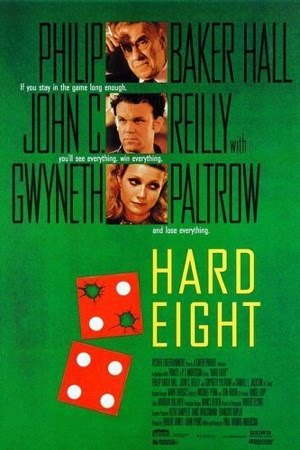
A really hard Eight


Remind me never again to try to introduce my wife to Paul Thomas Anderson's Hard Eight with noisy gardeners and barking dogs outside, a fussy baby in her arms and in the swing, and a talkative grandmother making regular and weird observations about the movie.

That's a joke, because Monday's specific set of circumstances will never come up again. But neither will the opportunity to introduce her to Hard Eight. That's already been ruined.

I have sometimes called Hard Eight, Anderson's first feature, my favorite Anderson film. That was almost certainly excess praise, especially since I'd seen it only once at the time I made the claim. I haven't repeated that assertion since seeing There Will Be Blood, but I obviously did make that assertion in the post Boogie Nights and Magnolia era -- since I saw both before I saw Hard Eight. My second viewing reminded me that it's a small but very good film.

However, I don't know how anyone else present could have possibly reached that conclusion, with all the hubbub in our environment, some of which they themselves were creating. Which is a shame, because my wife is a huge Anderson fan -- this was his only film she hadn't seen.

First it was the gardeners. Our landlord hires a team of gardeners to come shred up the property at least once a week. I say "shred" because I don't think they're actually trained gardeners with a genuine aptitude for horticulture. They just know how to operate the equipment -- the louder, the better. They leave the things they trim looking raw and exposed, maiming them with their brutish ways. The thing that galls me most, however, is that this one guy finishes the experience by making a call on his cell phone and just aimlessly spraying the lawn with his hose for the length of the call, leaving the place a boggy marsh and wasting tons of water.

So yeah, they were leaf-blowing and tree-mangling for the film's first 45 minutes.

Then it was my son Jasper's turn to become all fussy. He wouldn't quiet down. We'd put him in the swing, but he wasn't allowing himself to be soothed by it. So my wife would go over and tend to him, but tell us not to pause the movie, even if she weren't looking at the screen for two or three minutes at a time. And here's where my wife and I have a philosophical impasse. I get stressed out if she doesn't look at the screen enough, thereby missing crucial visual information, of which there is plenty communicated in Hard Eight -- but she gets stressed out if she asks me not to pause the movie, but I insist on pausing it because I don't want her viewing compromised. So I basically had to check my instincts and allow her to be as distracted by our son as she wanted to be, even if it meant her appreciation of the film was being fatally damaged.

Then it was the neighbors' dogs turn to be spooked by anything and everything in their environment. They are famous for standing at the fence, staring out at the street, begging anyone or anything to give them an excuse to create a ruckus. Usually this is when their owners aren't home, which was almost certainly the case this past Monday. So they would woof it up for 15 to 20 seconds, and then stop. And then just when you thought they had become placid and contained, something else would stimulate them and they'd get going again. This was all the more stressful for me because by this point, I had my son in my arms and was standing behind my mother, bouncing him as much as I could to contain his fussing. As the only one who had already seen the movie, I didn't care about whether I had an uninterrupted viewing, but I wanted everyone else to see in it what I saw in it, and that was rapidly seeming impossible.

The final obstacle was my mom herself. This being the first movie she and I watched together on the trip, it reminded me that she will one day make an excellent example of the senior citizen who goes to the theater and theorizes aloud to her viewing companion, irrespective of who it may or may not be bothering. She wasn't talking constantly, and she did seem to pick her moments. But the comments she made were bizarre indeed. One joke my wife and I have had on this trip is how she's fixated by the idea that she doesn't like John C. Reilly because she thinks he's ugly. She made at least one reference to that. Then she made a handful of what I would consider fairly obvious interpretations of what was happening, the kind that would prompt a son who was feeling snotty to say something like "Duh." But the weirdest was that she kept failing to understand that the action was taking place in Reno, which a title card early in the film had announced. First she said "I guess this is the kind of thing that happens in Vegas." I quickly corrected with "Reno," but I don't think she heard because later on, when Philip Baker Hall's character is trying to suggest a location where Reilly and Gwyneth Paltrow should go on the run, my mom decided to join in the conversation. "How about Vegas?" Reilly asks, and Hall immediately rejoins with "No, God no, don't go to Vegas." "Reno!" my mom suggested, as if the actors might hear her suggestion. I just bit my tongue this time, and probably rolled my eyes.

Both my wife and my mother said they enjoyed the movie. I wasn't particularly concerned with what my mother thought. We had a weird argument the next day about the next film we watched -- Kissing Jessica Stein, a favorite from my collection -- which essentially caused me to write off her ability to interpret even the simplest films correctly.

But I would have really liked it if my wife could have embraced this film, the way I know she would have without the gardeners, dogs, baby and mother-in-law.

Oh well. It's just one film. You can't win 'em all. Onward and upward.

Wednesday, September 22, 2010

To honor a filmmaker's wishes


Much has been made about how you're supposed to know as little as possible about Catfish before going in. In fact, the very poster says "Don't let anyone tell you what it is." That could refer either to the movie or the meaning of the title, I guess.

So I'm going to write a post about Catfish while honoring those wishes. However, if you don't trust my ability to successfully do that, you may choose to save this post until after you've seen the movie. This is not an official spoilers warning, because I don't plan to include spoilers. However, I probably will tell you something non-substantive about the movie that could almost constitute a spoiler depending on your definition of what you shouldn't know, relative to what you've been told you shouldn't know -- which is itself something I plan to talk about.

And I also plan to talk about a second movie, Crazy Love, in which I will include some spoilers, because the synopses of the film are happy enough to include those spoilers for you. I consider that sort of a disservice to the movie, but it's in the public record, so I'll go against my better judgment and reveal this particular information as part of the topic I'm exploring today.

Okay. Have we cleared out everyone who doesn't want to be here?

First let me tell you that you shouldn't expect aliens to appear in Catfish. There's such a campaign of secrecy going on about this movie, and so much discussion of the supposed twist it contains, that you really are expecting something out of M. Night Shyamalan's worst rough drafts to enter into this movie. But I use the word "supposed" in the previous paragraph for a reason. I think it's highly debatable that what happens in this movie is as much of a surprise as Ariel Schulman and Henry Joost think it is.

And in that sentence I've revealed a spoiler of sorts, which is, that the "twist" is not really as much of a twist as you think it's supposed to be. If you look at it in a certain way, the fact that you won't be so surprised is itself sort of a surprise -- isn't it? If you're expecting to be surprised, you watch the movie looking for surprises. If someone has told you that the "surprises" aren't really surprises, then you watch it with less anticipation -- and perhaps are less excited to see it to begin with.

So why, you ask, is there so much hype about this movie containing a twist, when the places it goes -- although somewhat unexpected -- are in many ways a logical offshoot of what you do know about the movie going in?

Specifically, because the fact that it has a twist is key to its marketing campaign. I'll admit to you that I probably would not have seen Catfish on opening weekend if I were not so concerned about having the twist ruined for me before I had a chance to see it. Creating this kind of buzz, this kind of urgency about a film, is undeniably helpful at the box office. Hey, they got $12.50 from each my wife and me on Sunday afternoon, and we're supposed to be savvy cinephiles who can see through marketing gimmicks.

Before I go much further, I don't want to give you the impression that Catfish is not a good movie. I actually like it very much. I just don't think the places it goes are as earth-shattering as the filmmakers think they are. However, I understand completely why they would want to market the film this way, especially since the film is a documentary. Documentaries obviously need all the help they can get if they want to make money, and if they want to bring 15 minutes of fame to the filmmakers, which could lengthen outward to a full career in the business if they're lucky.

But if any film deserved to be shrouded in secrecy, I think it was Crazy Love, the 2007 documentary by another duo of documentarians, Dan Klores and the actor Fisher Stevens (who once dated Michelle Pfeiffer, but that's another type of crazy love, with Pfeiffer being the crazy one). Crazy Love is about Burt Pugach and Linda Riss, a pair of New Yorkers who met in the 1950s, dated, and then went through a number of stages of stalking, obsession, and other acts that I wouldn't want to know about going in if I were a viewer.

But here's what a lot of viewers did know going in. I am excerpting this, word for word, from a very prominent synopsis of the film that I've seen reprinted multiple times, so you don't hold me responsible for revealing the information myself:

"Pugach desperately tried to convince Riss to give him a second chance and began stalking her, but when that failed and he learned she had decided to wed someone else, he told her, 'If I can't have you, no one else will have you, and when I get through with you, no one else will want you.' Pugach's statement was no idle threat -- a thug hired by Pugach threw lye into Riss' face in order to scar her for life, and ended up blinding her in one eye. The crime earned Pugach a 15-to-30-year prison sentence, but less than a year after he was released on parole, a peculiar thing happened -- Linda Riss and Burt Pugach got married."

Ugh. Don't say I didn't warn you.

I much prefer the Netflix synopsis, but wait for the "but":

"This documentary from director Dan Klores chronicles the disturbing true story of an obsessive relationship gone awry in 1950s New York between Burt Pugach, a married lawyer, and his twentysomething mistress, Linda Riss. In a shocking reversal of the traditional 'woman scorned' formula, it was Pugach who came unglued when Riss broke up with him -- and the subsequent fallout made headlines across the country."

Unfortunately, when Netflix lists the cast for the movie, it lists them as Burt Pugach and Linda Pugach. Anyone knowing that coming in would know that these two eventually married, despite a film's worth of mounting evidence to the contrary. Fortunately for me, I didn't specifically notice the names and couldn't quite remember whether they eventually married or not, so watching the film was full of the bizarre discoveries that Klores and Stevens (who is actually listed as a co-director, not a director) intended their viewers to make.

Why am I so sure that they'd have liked the secrets to be revealed during the course of their movie, and not during the synopses? Well, precisely because they reveal their legitimate surprises only gradually throughout the narrative. Some docos like to tell you up front everything that happened, then fill in the details. Not here. Crazy Love is structured as a true narrative story, its surprises left secret until the moment of maximum impact. In fact, they go so far as to interview Burt and Linda separately until the moment in the film that it's revealed that they ended up marrying. Then they start to interview them together. This keeps the viewer in constant suspense about the current status of their relationship until the exact moment that Klores and Stevens want to reveal it.

But there was no additional push in the advertising campaign to make sure that Crazy Love was shrouded in secrecy. Which is why irresponsible synopsis writers didn't seem to care about revealing the whole plot -- and I'm including in that the guy who synopsized it for the website I write for. It was probably somewhat futile, then, that in my review of the film, which I just wrote last week, I not only kept those secrets for Klores and Stevens, but I discussed the importance of keeping the secrets to the experience of watching the movie. And just hoped that my readers would read the review but not the synopsis.

Of course, comparing Crazy Love and Catfish in these respects is sort of comparing apples to oranges. Truth is, the exploits of Burt and Linda were all over the tabloids, so the synopses were only repeating what was already easy to discover on your own, numerous places in the historical record. Whereas the people in Catfish are not known outside the movie, at least not yet.

And to be fair, even if Crazy Love had been accompanied by advertising hype about its various "twists," it's still likely that far more people would have seen Catfish than Crazy Love. Catfish is set in the world of our modern digital age, using media and methods of communication that most of us utilize on a daily basis. Crazy Love, on the other hand, deals with with octogenarians whose most interesting stories occurred decades before anyone even had a personal computer. And though I'd have to think about it for a second, Catfish may be the more interesting movie overall, as well.

But it doesn't contain as many surprises as Crazy Love, assuming you're younger than 50 and didn't live through the craziness of Burt and Linda as carried out in the New York tabloids.

And if me saying that about Catfish has spoiled the potential experience of seeing the movie for you, well, don't say I didn't (unofficially) warn you.

Monday, September 20, 2010

One font ain't enough


On June 30th, I wrote that I considered almost all documentaries to be good, and that fewer than 10% of those I'd seen were movies I would not recommend to a friend.

Well, now you can add one more to the "dislike" list.

Over the course of this weekend, my wife and I watched Helvetica, an 80-minute documentary that took us three sittings to finish. That's right, we watched it about equally in thirds on Friday night, Saturday night and Sunday night.

Sure, part of this had to do with the fact that my mom is visiting, and she's been staying over at our place until 8:30 or 9:30 each night. This has left little time and energy for us to unwind before bedtime rolls around. We rarely see 11 p.m. anymore in the baby era.

But if Helvetica had been even slightly more interesting, we probably would have pushed through it on the first night. Or at least the second.

If the title and the poster above don't make it clear, Helvetica is a documentary about the Helvetica typeface. And that's about it. Really.

Yeah, it discusses the typeface industry in general. But all discussion points ultimately tie back in to this one font, which is supposed to be the world's most popular -- and the world's most rebelled against.

And how popular is it? Well, let documentarian Gary Hustwit show you. Let him include shots of where Helvetica is being used over ... and over ... and over ... and over again. Let him stockpile proof of the ubiquity of Helvetica until you want to gouge your eyes out.

I swear, without all the B-roll of signs written in Helvetica, this 80-minute movie would have been only 65 minutes long.

Helvetica is the poster child for the extreme amount of navel-gazing that can occur when documentary topics get whittled down to their most narrowly defined levels. Focusing on one very specific topic and demonstrating the unexpected breadth of its influence can be highly illuminating, if done correctly. Take this trio of documentaries that are essentially about very specific parts of language/communication: Fuck, The N-Word and The Aristocrats. The first two are about the societal uses of two very stigmatized words, and the last is about the history of a bawdy joke told by comedians throughout the generations. On the surface, each film seems like it might be so narrowly defined that it will collapse in on itself. But each film is fascinating in its own way.

Not so with Helvetica. Upon just hearing the description, you might think this film would have the ability to join the ranks of those above. Instead, it does in fact collapse in on itself.

Hustwit's relentless appetite for proving the popularity of the Helvetica font is bad enough. But what's worse is his interviews with various typeface designers and other questionably relevant personalities. The interviews are presented in no particular order with no narrative momentum of any kind, and each interview subject bends the discussion to his own design interests. Sure, Hustwit has prompted each to make sure he circles back around to discuss Helvetica, but the rest of what's there is the interview subject's own agenda. Making for quite the mishmash discussion of fonts and their influences.

The stuff that's really interesting in the movie -- like, how this popular font was developed and named (it's a variation on the Latin word for Switzerland) -- is in fact interesting and worth seeing. But if the movie were stripped down to just those bare interesting elements, it would have been about 13 minutes long.

And I can guarantee you that would have required only one sitting.

I will say, however, that Hustwit's most urgent point -- "Look at how popular Helvetica is!" -- was driven home when we stopped our streaming Netflix and looked at the home screen of the movie. And then looked at the home screens of other movies, just to be sure.

That's right -- Netflix uses Helvetica.

Friday, September 17, 2010

"Who the heck are those scary nuns??"


I'm totally on board with The Town, especially since it seems to bear a thematic resemblance to Gone Baby Gone, which Ben Affleck also directed, and which I respected immensely.

But before I knew what The Town was about, I was totally on board with it being about something else entirely.

And it has everything to do with those crazy nuns on the posters. Or in my case, on the billboards.

It was pretty smart for the advertising campaign to latch on to an arresting image that Affleck was pretty smart to put into the movie in the first place, but the first few times I passed a billboard for The Town, that's all I saw: unholy (and I mean that in the secular sense) psycho-ward nuns whose mouths were opened in some kind of bird call of insanity. I would always just catch a flicker of the billboard, not long enough to see the machine guns by their sides, or the back of what was either an armored vehicle, or the getaway vehicle that had just disgorged them.

So for a short time I imagined that "the town" referred to some kind of isolated hamlet where everyone was crazy. The movie itself might belong to the realm of psychological horror or straight horror, and the images would be something out of a movie by Tarsem Singh (The Cell) or Stanley Kubrick. (For the record, Kubrick is not a perfect fit for what I'm going for here -- but I feel like these nuns could have been at home in either A Clockwork Orange or Eyes Wide Shut.)

Of course, The Town is actually about bank robbers in Charlestown, Massachusetts -- and "the town" is short for Charlestown. That's something I'd have known if I'd been aware of Affleck's involvement from the beginning, and suffice it to say that these billboards did not have the headshots of the actors you see above, which would have instantly removed it from my imaginary realm of fantasy terror.

It's possible I'll actually get to see this one in the theater. My mother is in town until next Friday, and it remains to be seen if my wife and I will take advantage of her babysitting skills to see one movie in the theater, or more than one. If it's only one, we're probably focusing on Catfish, which I might have written about today if I knew enough about it to have an angle to write about (and to be honest, I'm glad I don't, given the many surprises it is supposed to have in store). If we see more than one, then movies like Never Let Me Go and Easy A also become contenders alongside The Town. I may try to steer her toward one of those, because a friend of mine is also trying to put together an excursion to see The Town -- and the only reasons I wouldn't do that particularly outing are because a) I'd be derelict in my fathering duties or b) my wife has "claimed" it for us to see together.

But let's hope that big-screen viewing materializes one way or another. Because even if they're just Ben Affleck and Jeremy Renner in Halloween masks, those scary nuns will be even scarier at a height of 25 feet.

Thursday, September 16, 2010

The stink of kiddie


In an age where almost all animated movies are appropriate for five-year-olds, do we really still need to make animated movies that are targeted at three-year-olds?

I may be wrong, but to me, Alpha and Omega (releasing tomorrow) has the stink of kiddie on it.

You've had the experience before. You pop in an animated movie, thinking it's one of the majority of theatrically released animated movies that are filled with pop culture references and winks to their adult viewers. These may not be clever references or winks, but at least you feel like part of the target audience. Then, anywhere from 30 seconds to five minutes into the movie, you realize it's just supposed to be a bunch of bright colors and shapes that will please babies.

Last time this happened to me was last year with Battle for Terra, which featured a very simplistic version of the already simplistic Avatar story (before Avatar was released) in a way that instantly struck me as developed for human beings who were teething.

Back in the day, it used to be easy to tell what kind of animated movie you were getting just from the quality of the animation. When another Winnie the Pooh movie hit theaters, you could be 100% certain it had nothing to offer you, if only because the animation was the furthest thing from cutting edge you could imagine. Now, however, the technology exists to make reasonably credible visuals without giving away your meager means. You can still tell if you look closely, but the average viewer is easily fooled.

So how are you supposed to avoid watching a kiddie movie -- that is, assuming you're not carrying around a little one in a Baby Bjorn?

To assist you in this scenario are Vancetastic's Five Indicators Your Movie is Meant for Toddlers:

1) The characters are all voiced by actors under the age of 12, rather than comic actors who appear in Judd Apatow movies;

2) The trailer is narrated unironically by that guy who did voiceover for that toy commercial you accidentally saw once while channel surfing;

3) Any humor in the trailer has to do with the male character falling on his butt while meeting cute with the female character, or inoffensive bathroom humor;

4) The trailer music is cheesy "adventure music," and the movie is usually about a cheesy adventure of some sort;

5) The animation is at least 20% less sophisticated than Pixar.

Maybe they should also come up with a new rating that's less than G, that says, "Don't watch this unless at least one person in your family cannot form complete sentences."

To be fair, Alpha and Omega already violates at least one of these rules. None of Dennis Hopper, Justin Long, Hayden Pannettiere, Danny Glover or Christina Ricci are under 12, and only Long, Pannettiere and Ricci can play under 12. But you get the idea.

I watched the trailer for Alpha and Omega again just now, and I realize I'm being a bit unfair to it. The animation may only be 15% less sophisticated than Pixar, and it's really working at more of a 7-year-old reading level than a 3-year-old reading level.

But I guess the point in any exaggeration is to illustrate something true, and in this situation, the true thing I'm trying to illustrate is that the most successful animated movies of recent years have made themselves into increasingly sophisticated entities, leaving a huge gulf between them and the ones that are not quite so advanced. Whereas something like Bambi was as much sophistication as anyone needed back in 1942, today, Bambi would be considered highly square, even by pretty young tots. Today, the animated movies kids want to see are the Despicable Mes and the Megaminds, where an evil genius has mastery of high-tech computer equipment. Movies where animals prance through the forest -- like Bambi, and like Alpha and Omega -- are therefore ghettoized as something best suited to show fetuses who are still in their mothers' wombs.

Well, good luck, Alpha and Omega. May you exceed your kiddie stigma at the box office.

Wednesday, September 15, 2010

Just a bit of Taylor


It's only 53 minutes into the post-Blockbuster era, and I already have a complaint with Netflix.

It's not an insurmountable complaint, to be sure. But I did think the timing was funny.

I added Drillbit Taylor, a movie I will be reviewing, to my Netflix Instant Queue a couple days ago, and noticed that it was only available for instant viewing until 9/15.

I didn't realize that Netflix operates kind of like OnDemand, where movies are only available for a finite period. I thought the point was that Netflix was working toward making its entire inventory available for instant viewing, albeit with the expectation that this would not happen for many years. Still, I thought that once a movie was available, there was no going back -- it was available for good.

The Drillbit Taylor incident told me otherwise. However, I was prepared to live with that. And to take advantage of this closing availability window, I started watching Drillbit Taylor yesterday after work. When I succumbed to a nap, I told myself I'd finish it either Tuesday night, if I had to be awake weird hours for baby duty, or at worst Wednesday after work, before it was whisked out of virtual existence.

As it turns out, the weird hours of baby duty did indeed kick in -- and even though the baby is now sleeping in the other room, I'm still wired. So I thought I'd finish the half I had remaining.

Only, Netflix has a weird definition of what "available until 9/15" means. See, they cheated me out of one day. When I tried to resume from where I left off, Netflix told me this title was not available for instant viewing. The title appeared on the screen, the Resume Playing option was still active, yet there was no movie to be found. At least when OnDemand takes something away from you, it lets you watch it for the entire first 23 hours, 59 minutes and 59 seconds of the last day of its availability. Netflix, on the other hand, pulled the plug as soon as the clock struck midnight on the expiration date.

I also can't help but notice the contrast with Blockbuster, who, even after I ended my relationship with them, told me I could continue watching the three videos I had out for a whole month more, before I would be charged for them. September 15th was also the supposed expiration date there.

Don't make me come over there, Netflix.

Tuesday, September 14, 2010

To end at the beginning


I watched my last movie as a Blockbuster Total Access customer last night.

Appropriately enough, it was the first movie where anyone ever spoke a line of dialogue -- or gets credit for being that, anyway.

That's right, after whimpering about the decrease in Blockbuster's services and locations on my blog a half-dozen times earlier in the year, I'm now going out with a bang, as it were -- suddenly, and without any advanced warning. I'm paid up through tomorrow, and I'm on the verge of letting my subscription for online rentals lapse. In fact, I will officially do it at some point during the writing of this post.

The choice of The Jazz Singer as my last movie was not intentional or symbolic. It just so happens that I'm watching movies from the 1920s in September as part of my Decades series, and it happened to be time to watch the movie that gets credit for ushering in the "talkie" era. But in retrospect, there was something appropriate about it.

Appropriate because I have been doing things "the old way" for way too long, and it's time to step into the next generation of film renting. That started about a month ago, when we got our first BluRay player, which, perhaps more relevantly, is also capable of streaming Netflix. Watching streamed movies on my TV has become my immediate preferred method of doing things, and has made the long drives to pick up movies from -- and then return movies to -- Blockbuster locations seem increasingly tedious. I don't know if we would have gotten to this point if I had a Blockbuster on the corner, but it takes me a good 10-15 minutes to reach the closest one now, and that just ain't cutting it.

I had been making noise about quitting Blockbuster for a long time now -- the writing was on the wall. But my wife sensed that I needed a bit of a push out of my comfort zone, so earlier in the summer we discussed that I could use the purchase of the BluRay player as my impetus to finally pull the trigger. That gave me a couple months still to "appreciate" Blockbuster, since we didn't plan to buy the Netflix streamer until just before our child was born.

Because I have appreciated Blockbuster, as strange as that sounds. I know they are a faceless corporation that you are supposed to hate with the kind of vigor reserved for WalMart, but I have never hated Blockbuster that way. Their customer service has always been excellent with me -- I can't say the same for Netflix, when I used to be a customer and when I considered becoming one again -- and I have always enjoyed the benefits that I used to consider them to have over Netflix. Back in the glory days, you used to be able to exchange your on-line rentals at the store and get both an in-store rental, and the next movie in your queue sent to you. Since there were two Blockbusters about equidistantly close from where I lived, this was an option I availed myself of regularly.

Well, first they changed that policy so that you didn't get your next rental through the mail until you returned your in-store rental. Then they closed first one, then the other of those two closest Blockbuster stores. And even after I adjusted to that, I've found that a lot of the titles I'm really interested in renting online have statuses like "Short Wait," "Long Wait," "Very Long Wait" or even the dreaded "Unavailable." As my online queue became strewn with the corpses of interesting movies Blockbuster was never going to be able to ship to me, I realized what the rest of the world realized a long time ago -- Blockbuster, as currently constructed, is an unsupportable business model that may not exist in this form for very much longer.

But because Blockbuster has been so good to me -- never questioning me when I say a movie got lost in the mail, always sending me extra coupons to make good on their mistake, etc. -- I do feel a little bad abandoning them like this. Every customer who drops their service drives one more nail into their coffin.

I know that if a company like America Online still exists, somehow, then Blockbuster will, too. Rationally, I know that the $20-something per month I will no longer be paying them will not be felt, really, at any level of the organization.

But I still feel bad. Because you have to mourn the little changes that come along like this, as they come along. You had to mourn the closing of the music stores, and now you have to mourn the eventual closing of the video rental stores, which is happening sooner rather than later. Kiosks, while very handy, can only do a partial job replacing what video stores, in their prime, could offer us. (And I guess I should pause to say that I'm glad that the smaller video stores, with less overhead, seem like they could still thrive for a little while longer.)

So how do I plan to manage my rentals going forward, without Blockbuster?

Well, I mentioned kiosks in the previous paragraph. Redbox is sure to pick up a bunch of the slack on new releases, movies that may have an initial backlog if you try to rent them through Netflix. And for new new releases -- the ones Blockbuster has been getting up to 28 days before Redbox and Netflix -- I can actually still avail myself of the Blockbuster kiosks, the first one of which I saw in a local Pavilions grocery store the other day. I'm hoping that the kiosks will still get those movies ahead of the competition, so this will give me access to the newest video releases while still letting me demonstrate my remnants of customer loyalty to Blockbuster.

Then we'll be increasing the number of rentals from Netflix we're allowed to have out at any given time. Currently, my wife is on the modest one-disc-at-a-time plan -- the streaming has always been more interesting to her than the physical DVDs (she's so advanced compared to me). I've always been a big proponent of pooling our resources now that we're married, and keenly, she used that argument to get me to drop Blockbuster and take an ownership role in her Netflix queue. In reality, I will probably have the run of that queue, still able to get the rare movies I want to see (a better selection of them than Blockbuster, probably), either because I've heard they're good or because I need to review them. And with acceptance of Netflix comes forgiveness of Netflix, for a customer service blunder that was now so long ago that I won't even bring it up here.

In case I miss renting movies in the original cases they came in, there's always the good old reliable library. And hey, if I'm feeling really nostalgic, I can always walk into a Blockbuster and actually plunk down the ridiculously high rental fee, something on the order of $5. I'll still have my membership card, after all. I'm still a Blockbuster member, they just won't be drawing a regular payment from my credit card, nor get the lion's share of my business.

And I may still use them for another valuable purpose, one that I was worried about losing by dropping Blockbuster: aisle browsing. One of my biggest concerns is that I would lose my ability to browse a large number of unfamiliar titles, which a person can only do effectively in the new release section of a brick-and-mortar video store. But then it hit my like a lightning bolt a couple weeks ago: I can still do that. There's nothing to keep me from walking into a Blockbuster, browsing the hell out of that new release section, jotting down some titles I wasn't familiar with previously, and then walking the hell out.

So this morning I took The Jazz Singer and the first disc of the first season of Party Down, and dropped them in the mailbox on the corner. I wanted to guarantee that I returned them before the 15th, so I don't have to make a partial payment on next month's bill, and that also committed me to being sure I actually pulled the plug on Blockbuster today, so they don't receive them and send me the next movies in my queue. The ceremonious last act will be returning my in-store rental of the execrable Furry Vengeance later today -- and then my books will be square with Blockbuster.

So without any further ado, here I go, pulling up the Blockbuster website, to do the dirty deed.

But first, some printing. Before cutting ties, I had always wanted to print out my queue, so I could recreate as much of it as I wanted on Netflix. Then, while I was at it, I decided to print out my rental history, which goes 200 titles back, getting us back to March of 2009. Yep, I used this thing a lot.

Then, on to the fateful page. I clicked the My Account link, then under the Subscription Plan area, I clicked the Cancel link. Needless to say, they weren't going without a fight. They offered me a number of lower-level plans, some of which came to as little as $4.99 a month. They even offered for me to put my subscription on hold for as long as three months. But I couldn't be swayed by these options. It's like taking off a bandaid -- you just have to rip it off. I moved my mouse to the blue "Please just cancel my subscription" area and clicked.

Then of course had to fill out a survey about why I was leaving. Well, given my fondness for them as a corporate entity, the least I could do was explain my reasoning. And even though I chose "I am trying to cut expenses" as the reason for canceling (and that's legitimate, especially when I discovered yesterday how much my son is costing me in health insurance), I went on to include the following comment:

"The two closest Blockbuster stores to me have closed, and now it's very inconvenient for me to get to the next closest store. I considered the in-store exchange aspect of the subscription to be one of its primary benefits over Netflix, but was no longer making regular use of that after those two stores closed. Plus, I found too many titles on line that were listed as "Long Wait" or "Very Long wait." One way to assist with the inconvenience of getting to the store would be to implement a system where you can return your video to any Blockbuster within a 25-mile radius, or something like that. Being able to rent from one store and return to another would have helped. But, it wouldn't have helped enough. I enjoyed being a Blockbuster customer when it met my needs, and I have always appreciated the high quality of Blockbuster customer service -- thank you. Unfortunately, it's just not meeting my needs the same way it used to."

Probably more than I needed to give them, but hey, like I said, they're alright in my book.

I skipped one more chance to keep my subscription active, and clicked Continue With My Cancellation.

The next page told me the cancellation was successful, and that I actually had until 10/15 to return my videos to avoid being charged for them.

Maybe I'll watch Furry Vengeance ten more times, just to wallow in nostalgia.

Good luck, Blockbuster. Don't go bankrupt on my account.

Monday, September 13, 2010

Making lists about making porn


There was one reason and one reason only that Finding Bliss was on our Netflix Instant Queue at home: My wife and I have already seen every other movie about the porn industry, so might as well see this one.

That's a bit of an exaggeration, but in the last couple years, we've watched a succession of movies involving the sudden exposure of ordinary people to the sketchy world of adult entertainment. As it happens, Finding Bliss came a bit too much on the tail end of that trend to have anything new or interesting to say -- and it was pretty cheaply produced, so it resembled an actual porn in more ways than it should.

Well, you know how my mind works ... let's devote a special post to movies about porn, and while we're at it, might as well rank them. I couldn't do a top ten, because I could only think of nine movies I'd seen that I thought fit the category. But without any further ado, here is my top nine:

1) Boogie Nights (1997, Paul Thomas Anderson)

Synopsis: A busboy (Mark Wahlberg) in 1970s Los Angeles is discovered by a porn producer, and becomes one of the industry's biggest stars on the strength of his exceptional endowment -- while also getting consumed by the whirling dervish of drugs and partying that this lifestyle entails.

My take: Paul Thomas Anderson's second best film (behind There Will Be Blood) is a masterpiece that established Anderson as capable of documenting unknown social infrastructures in a way that earned justified comparisons to Martin Scorsese. While this is certainly a serious film, it does have doses of the humor that characterizes most of the films to follow on this list.

2) The Girl Next Door (2004, Luke Greenfield)

Synopsis: A high school senior (Emile Hirsch) becomes infatuated with a mysterious blonde about his age who lives next door (Elisha Cuthbert) -- and has already struck up something of a relationship with her when he discovers she's working as a porn actress.

My take: This unapologetic update of Risky Business is a lot more fun than you would expect it to be, with great performances (by both of those listed above, but especially by Timothy Olyphant as a porn director/thug) and a terrific soundtrack from start to finish. It's both a good coming of age story and a funny spoof of the porn industry -- definitely worth a look if you've had your doubts to this point.

3) Zack and Miri Make a Porno (2008, Kevin Smith)

Synopsis: Two broke best friends (Seth Rogen and Elizabeth Banks) decide to make a porn movie -- in which they may or may not be actors -- in order to help pay off their debts, and realize they may have genuine feelings for each other.

My take: Just when you thought Kevin Smith didn't have anything more of use to contribute to Hollywood, along comes this surprisingly heartfelt and maturely shot/written movie about two slackers trying to make an adult film. What's so surprising about it is that it has two equally strong sides that seem like they should oppose each other -- the well-developed friendship/relationship between Rogen's and Banks' characters, and the gross-out style humor inherent in porn filmmaking. The two halves of the film compliment each other excellently to make a memorable film.

4) Orgazmo (1997, Trey Parker)

Synopsis: A devout young Morman living in Los Angeles named Joe (Parker) needs to make enough money to move back to Utah and marry his girlfriend. When a porn producer sees his martial arts skills in action, he hires him to star in a porn movie in which those skills would be utilized -- but not Joe's actual body during the sex scenes, or so he's promised.

My take: Forget South Park: Bigger, Longer and Uncut -- this is actually Trey Parker's funniest film. Like Zack and Miri, it has hilarious gross-out stuff without giving its male viewership anything too titillating: Every time you're about to see some hot female nudity, Parker throws a man's hairy ass into the frame to block it out. Who would have expected anything less?

5) The Amateurs (2005, Michael Traeger)

Synopsis: Feeling out-fathered by his son's rich new stepdad, a hard-on-his-luck small-towner (Jeff Bridges) has a drunken inspiration with his friends at a bar that the best get-rich-quick scheme is to make a porn movie.

My take: This under-the-radar film sings on the strength of a great lead performance by Bridges (whose narration is one of the film's strong suits) and affable supporting performances by a wide range of likable actors (Ted Danson, William Fichtner, Glenne Headley, Joe Pantoliano, Lauren Graham, Tim Blake Nelson). A surprisingly sweet film that reinforces the good sides of all the people who are trying to do a not-so-good thing.

6) I Want Candy (2007, Stephen Surjik)

Synopsis: Two London film students (Tom Burke and Tom Riley) are looking for funding to make their legitimate student film, but come into debt to a porn producer who wants them to make it into an adult movie starring American porn star Candy Fiveways (Carmen Electra), which they proceed to shoot in one guy's parents' house.

My take: Another sweet movie about the porn industry in which most of the characters have their moral compass ultimately pointed in the right direction, I Want Candy is also a really smart move by Electra, whose character never has to show her goods (though she appears scantily clad many times) -- it seems like a step up for Electra after appearing in all those _____ Movie movies. Funny performances and an all-around unexpected surprise.

7) Rated X (2000, Emilio Estevez)

Synopsis: Biopic about real-life porn entrepreneurs Jim and Artie Mitchell (Estevez and his real-life brother Charlie Sheen), who discovered Marilyn Chambers and made the "classic" porn film Behind the Green Door before their lives spiraled into the inevitable hell of drugs and professional failure.

My take: And here is the stark line of demarcation between the films on this list that I like and the films that I don't. There is some promising low-level Scorsese-style stuff in this film, as we follow the brothers down through the years and their lives become distorted and fucked up. However, it's ultimately pretty chintsy on the production values -- the bald caps worn by the two brothers look ridiculous -- and the brothers themselves don't make very interesting subjects. Befitting of a movie that premiered on cable (Showtime).

8) Finding Bliss (2010, Julie Davis)

Synopsis: An award-winning film school graduate (Leelee Sobieski) can't find work when she reaches Los Angeles, her desperate attempts to get in touch with Garry Marshall (who presented her graduation award to her) falling flat. She interviews for work as an editor at what she quickly discovers is a porn studio, but takes the job because she thinks she'll be able to use their sets and cameras to shoot her own script at night.

My take: Finding Bliss suffers from a "been there, done that" quality from the get-go -- it just doesn't have much new to say after so many movies on the subject had previously been made. The basic shocks of porn have already been seen, the message already conveyed that the legit filmmaker could use a little more porn in her mentality and the porn industry could use a little more legitimacy. What's worst about this film is how poorly it's lit, which makes it resemble an actual porn a lot more than one might like. As a bonus, however, there's a scene of full-frontal nudity featuring the well-endowed Jamie Kennedy of all people -- as a narrative drawback, the scene is utterly pointless and has nothing to do with the making of an actual porn scene.

9) The Pornographer (1999, Doug Atchison)

Synopsis: A porn addict (Michael DeGood) starts dabbling in making his own porn movies, and catches the attention of a porn producer, who suggests he might have a future in the porn industry if he can only find the right star (Katheryn Cain) to bet on.

My take: And here's why movies about the porn industry that aren't funny (other than Boogie Nights) don't work. The truly lurid side of making adult movies is so lurid that we have to place it in the context of comedy or else it's just too depressing. The movie, which I don't remember very well since I saw it nearly ten years ago, features usury and both emotional and physical violence. The movie is also pretty cheaply made, so it doesn't even get the chance to be like something Ken Russell (Whore, Crimes of Passion) would have made.

In researching this list, I also found a hit list of movies I probably should see if I want to ultimately have a definitive ranking of the movies out there on this topic. They include:

Middle Men (2010, George Gallo)
Wonderland (2003, James Cox)
The Fluffer (2001, Richard Glatzer & Wash West)
Shooting Porn (1997, Ronnie Larsen)
Naked Fame (2005, Christopher Long)
The Last Porno Flick (1974, Ray Marsh)
Porn 'n Chicken (2002, Lawrence Trilling)
Shakespeare In ... and Out (1999, Peter Shushtari)
National Lampoon's Barely Legal (2003, David Mickey Evans)
Deep in the Valley (2008, Christian Forte)

What have I missed? What's your take on the movies about making porn?

Friday, September 10, 2010

Nowhere to go After this


When the first Resident Evil came out, it implied that the world was in pretty big trouble.

Yeah, the outbreak of zombie-ism occurred in an underground military-style laboratory -- forgive me if I'm hazy on the details, I haven't seen it since it was in the theater in 2002. But I believe the plague had already advanced pretty far by the end of the movie, when our fair protagonist, Alice (Milla Jovovich), finds herself in a city completely overrun with zombies. She's left with the seemingly impossible task of picking them all off, all by her lonesome -- video game-style, you might say. And it seems like that's probably that for poor Alice.

Of course, Resident Evil did well enough to inspire at least three sequels, the most recent of which is hitting theaters today -- and is of course shot in 3D. (Actually shot this time, I think -- from the trailer I saw before Piranha 3D, the 3D looks too good to have been retrofitted.) So Alice not only survived that seemingly impossible situation, but went on to thrive, even if the hows and whys have not been a strong suit of the Resident Evil sequels.

By far the worst of which, so far, was Resident Evil: Apocalypse, which came out in 2004. The fact that it was an incomprehensible mess is not really germane to my argument. Rather, it's the title I'm interested in. The title set up an ascending name convention that is still alive today -- though possibly not for very much longer.

The subtitle -- is that the right word? -- Apocalypse has a certain finality to it, doesn't it? It kind of says "Yes, what you thought might happen has happened. Zombies have taken over the world. This is the apocalypse."

But perhaps because Resident Evil: Apocalypse was such a piece of shite, the people who own the rights to the franchise felt like they had to make a third, to restore the series' "good name." In 2007, they brought in a third director, as Russell Mulcahy took the baton first passed from Paul W.S. Anderson to Alexander Witt, and made a really promising trailer for a film in which Las Vegas is almost totally submerged in sand. This eye-popping image got me excited for Resident Evil movies again, and they called this one Resident Evil: Extinction. It may be the most fun Resident Evil movie to date.

Let's look at those titles again. Okay, if Apocalypse wasn't bad enough, now we've reached the Extinction phase. That's right, there will be no humans left after this movie. I guess you could say that every extinction is preceded by some kind of apocalypse. The apocalypse is the shocking moment of recognition, and the extinction finishes the job. It's a logical progression. But there's nowhere to go after that, right?

Wrong.

Now we have Resident Evil: Afterlife, returning to the series' roots by putting Anderson back at the helm. Duh! I'm smacking my forehead. With all the humans dead -- though, I must say, I don't think that actually happened at the end of Resident Evil: Extinction -- this movie must feature a bunch of largely theoretical skirmishes between ghosts in heaven or hell. Doesn't that make logical sense? Isn't that where this titular progression has delivered us?

If so, what about Resident Evil 5? Where does one go after the Afterlife?

I'm taking suggestions. Although this would paint them into another corner of certain finality, they could call it something like Resident Evil: Game Over. It would be a good nod to the video game origins of the franchise. Or perhaps Resident Evil: Endgame, which expresses the same thing, but shies away from the video game origins, which they may actually think is key to reaching a wider audience. Or they could just start the clock over with something like Resident Evil: Rebirth or Resident Evil: Reborn. Though that doesn't express nearly the amount of pessimism we're accustomed to in these titles.

Here's my real prediction: If Resident Evil: Afterlife does reasonably well -- and there's no reason to think it won't be a solid enough performer, like the other movies in the series -- it'll officially be time for a reboot. Oh, I don't think they'll jettison Alice -- she's been through so much already -- but that doesn't mean the whole thing can't be advertised in the context of some kind of "new beginning." Maybe they'll call it The Resident Evil, just so we understand the distinction.

Let's just put it this way: No one in Hollywood would ever allow him/herself to be boxed in by adhering to some arbitrary naming convention. Where there's money to be made, it's probably a lot easier to come up with a decent title than a decent movie.

Tuesday, September 7, 2010

Best of paternity leave


Because my wife's family lives in Australia, my family lives in New England, and we both like to discover new destinations when we don't have to visit our families, my vacation time is pretty much spoken for.

It was like its own kind of exotic destination, then, to dream of a break from work in which I'd just sit at home watching movies, eating bad food.

This past week, I reached that exotic destination, albeit with help from a baby who needed changing and cradling at regular intervals.

That's right, watching movies was a major component of my so-called "paternity leave" -- which actually was a vacation, in the sense that I had to use vacation days to do it. My company doesn't give you any paid family leave -- you just get a guarantee that your job will still be there when you get back. You can actually take up to six months, but then you have to figure out how you're going to pay for diapers while you're not working.

I watched 21 movies in 9+ days home from the hospital. (Just to make things a little easier, I'm going to include the 2.5 movies we saw in the hospital -- The Proposal, The Baxter, and half of Ghost -- as part of my "hospital stay," not as part of my "paternity leave.") Why so many? Well, your options are pretty limited when you have a baby. Fortunately, they can also sleep through almost anything. So we just plunked our son down in his cradle in the living room, and made use of our streaming Netflix and the physical DVDs and BluRays we rented from the library, Netflix and Blockbuster. Under normal circumstances, we would have watched a fair amount of TV during this time as well, but it being the end of the summer, our DVR had been pretty much picked clean. This suited me just fine, as I'm always more interested in movies anyway.

You know I like ranking things, so why not rank the movies I saw while I was out of the office?

They fall into three categories: 1) Movies that my wife and I were both seeing for the first time; 2) Movies that one (usually me) or both of us had already seen; 3) Movies that I watched by myself, most likely because I had to review them. And when I'm ranking them, I'm not necessarily ranking them only on their absolute quality, but how they fit into our needs at the time we watched them.

So, here goes:

Movies we were both seeing for the first time:

1) Date Night (2010, Shawn Levy). Big mea culpa here, as I was a big doubter of this movie. We watched it Sunday night after our first full day home, which was a very good day, even though we should have been dog tired from our recent ordeal. But Steve Carell and Tina Fey -- and the many hilarious cameos -- made us laugh and laugh. A real winner.
2) Chop Shop (2008, Ramin Bahrani). Strange choice for second on this list, as this serious indie didn't fit into our quest for light and comedic entertainment, and I had to stop watching after 15 minutes yesterday afternoon in order to take a nap. But upon completion, I really liked this movie set in Queens, in which a 10-year-old boy works five jobs in order to save enough money so he and his sister can buy a roach coach.
3) I'll Believe You (2007, Paul Francis Sullivan). Although I'm reviewing this, my wife watched it with me, so it counts in this category. A small indie comedy about aliens and conspiracy theories starring some familiar comedic faces (Patrick Warburton, Chris Elliott, Ed Helms). Low-budget and funny only in spurts, it was nonetheless more enjoyable than the other films on this list.
4) The Runaways (2010, Floria Sigismondi). Stylish rock biopic that had no substance that interested me at all. Though I liked Kristen Stewart as Joan Jett, neither she nor Dakota Fanning (who's in the midst of an awkward growing-up phase) made me feel the emotional journeys of their characters. In the end I found it pretty tedious and boring.
5) Legion (2010, Scott Stewart). Only good scenes were in the trailers, and those scenes were not even very good. This movie is scattershot and boring. I wish I had anything positive to say about it, but I don't. Although, I guess I sort of liked that scene where the grandmother scampers up the wall of the diner. We had been "saving" this -- for no good reason, it turns out.
6) The Back-up Plan (2010, Alan Poul). Insipid, predictable and charmless throughout. I may devote an entire post to why I think Alex O'Loughlin sucks so much.

Movies at least one of us had already seen:

1) Parenthood (1989, Ron Howard). I don't know for sure that this was the best of the following movies, but I do know that it was the most pleasant reminder of how good it is. I turned to my wife and described it as a "perfect movie" after the credits rolled. It holds up incredibly well for a 21-year-old movie, and each plot is well-developed, heartfelt, and insightful. Bravo, Parenthood.
2) Dirty Rotten Scoundrels (1988, Frank Oz). Another Steve Martin starrer (we actually saw three Martin movies on my paternity leave) that was better than I remembered it being, even though I'd remembered liking it. It was a fight to get this started, as we originally couldn't get good enough Netflix streaming on it, leaving it pixelated and unwatchable. But we finally bested that obstacle and were richly rewarded with a movie that's hilarious and exquisitely unsentimental -- mainstream comedies rarely get to be so unsentimental these days.
3) Step Brothers (2008, Adam McKay). My affection for this movie runs so high that I can't believe I am ranking it only third here, but I have to admit that I was not quite as enthralled on my third viewing as I had been on my previous two. That is probably inevitable. I still think this movie is absolutely freaking hilarious, and it was a fun headliner for my final Saturday night of paternity leave.
4) Star Trek (2009, J.J. Abrams). As I already wrote about, looked great on BluRay. A truly fun movie.
5) The Purple Rose of Cairo (1985, Woody Allen). The only movie on this list that my wife had seen but I hadn't. I found this delightful, funny, and bittersweet in its unexpected coda. Something I had been meaning to see for years finally got watched on Friday night.
6) Cloudy with a Chance of Meatballs (2009, Phil Lord). Actually more fun than I remembered it being. But it's still a relatively minor animated film in the scheme of the last couple years.
7) Boys on the Side (1995, Herbert Ross). One of my favorite true chick flicks of all time. I was eager to show it to my wife, and was glad she seemed to like it as much as she did, as I felt myself just a wee bit impatient with it this time, on my third or fourth viewing.
8) It's Complicated (2009, Nancy Meyers). A bit too long, probably, but this is one of Meyers' most likable and most observant movies, with a terrific cast (Meryl Streep, Alec Baldwin, Steve Martin, John Krasinski). Never has divorce seemed so richly, well, complicated, and so full of fond laughter.
9) Waking Up in Reno (2002, Jordan Brady). That this is last on the list says more about the quality of the list than it does about this modest little romantic comedy with the likable foursome of Patrick Swayze, Billy Bob Thornton, Natasha Richardson and Charlize Theron -- two of whom, I sadly realized, are now dead. Miramax shelved this wife-swapping road movie several times before mercifully releasing it, but it's actually pretty fun, and the characters are sweet if flawed.

Movies I watched by myself:

1) Zulu (1964, Cy Endfield). Already extensively praised this in this post, so check there for my thoughts. A great film.
2) Hairspray (2007, Adam Shankman). Simply delightful. It's probably a tad too long, the consequence of being an adaptation of a Broadway musical, but I found that this movie oozed cuteness throughout. That can be a backhanded compliment, but it's not here -- "cute" is strong praise in this context. Loved the production design, loved the performers.
3) Machete (2010, Robert Rodriguez & Ethan Maniquis). Wrote about this one here.
4) Tyler Perry's Meet the Browns (2008, Tyler Perry). The best of the movies I watched in order to review them. And because my wife wasn't watching them with me, that usually meant I was watching them in pieces, while up at 2 a.m. or 5 a.m., rocking the baby to sleep. Aside from an utterly pointless Madea scene that I will be sure to harp on in my review, this is a nice story about a single mother (the always wonderful Angela Bassett) trying to make it, with help from a well-meaning former basketball star (real-life former basketball star Rick Fox).
5) Left Behind: World at War (2005, Craig R. Baxley). The third and final movie in the series starring born-again Christian Kirk Cameron, about the Rapture and its aftermath. I reviewed the first two, so I thought I'd make it a threesome. These are not good movies, but they are not as bad as you'd think they are, either. The third movie continues in that vein, and is probably slightly better than it should be because of a fun appearance by Lou Gossett Jr. as the president of the United States.
6) My Summer Story (1994, Bob Clark). You'd hope the sequel to A Christmas Story would be better than it is, but it's just not. Jean Shepherd is back narrating, and everyone else is a reasonable facsimile of the actor who played the character in the classic original -- with one glaring exception. As the old man, Darren McGavin's large shoes are filled terribly by Charles Grodin, who submits one of the worst cases of over-acting I have ever seen and absolutely torpedoes the movie. It doesn't help that all the little vignettes are pointless.

Faces who kept on showing up: Steve Martin, Mary Steenburgen, Whoopi Goldberg, Michael Caine, Tyler Perry. Okay, with Whoopi, I'm cheating a bit and including that half of Ghost.

Okay, back to work ... and back to all future vacations involving ridiculous amounts of travel.